Titanium surgical guides and guided implant surgery: why laboratories are switching to laser sintering
Prosthetics and guided implant surgery: a process that is now inseparable
Modern implant prosthetics can no longer be separated from implant planning and guided implant surgery. Today, the dental laboratory is at the heart of the implant-prosthetic workflow: acquisition of CBCT data, intraoral STL files, digital wax-ups, aesthetic planning, implant planning, and the design of surgical guides via 3D printing.
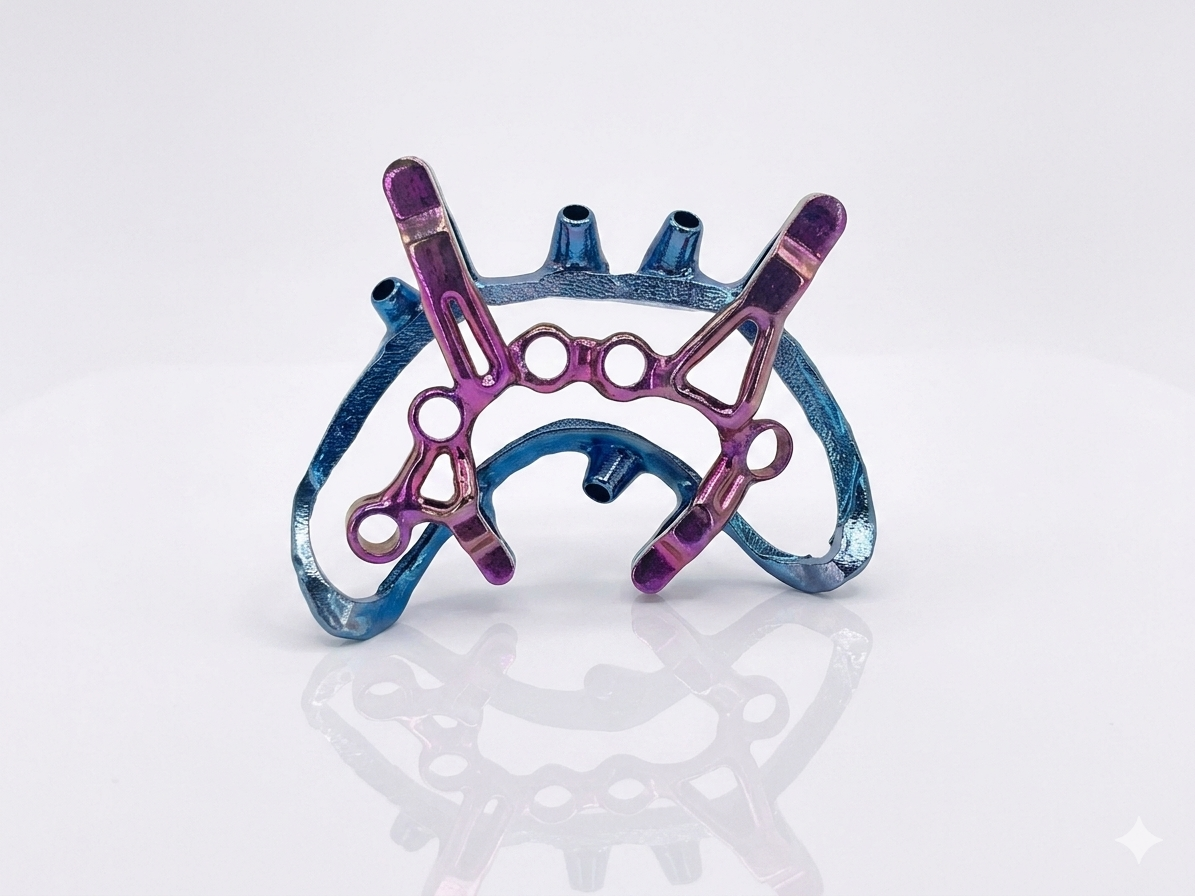
In this context, the titanium surgical guide becomes a strategic component of the digital workflow. It ensures that the implant-prosthetic plan is accurately translated into the surgical procedure. The precision of implant placement determines:
- prosthetic emergence,
- management of threaded shafts,
- occlusal stability,
- tissue integrity,
- long-term maintenance.
Guided implant surgery is no longer limited to serving as a surgical aid. It has become a tool for ensuring clinical safety and prosthetic performance.
Why choose a titanium surgical guide over a resin guide?
While resin-based 3D printing remains widely used, its mechanical limitations become apparent in demanding cases: complete edentulism, All-on-4/All-on-6 protocols, flapless surgery, and immediate loading.
The titanium surgical guide, manufactured using selective laser sintering (SLS) for implantology, offers decisive advantages.
- Superior structural rigidity
Titanium ensures optimal mechanical stability during drilling.
No bending, no micro-deformation, even under repeated stress.
This rigidity is essential for:
- limit angular deviations,
- maintain the specified tolerances,
- protect sensitive anatomical areas (sinuses, inferior alveolar nerve).
- Dimensional accuracy and STL fidelity
The process of laser sintering in implantology enables an extremely accurate reproduction of the STL file validated during planning.
Scan-to-STL comparisons demonstrate a precise match between the digital design and the manufactured part. This precision ensures:
- a passive adjustment,
- perfect stability,
- complete implant-prosthetic integration.
- Thermal Safety and Sterilization
Titanium withstands sterilization cycles perfectly.
Unlike certain resins, it does not deform or suffer surface damage.
- Premium coverage for complex cases
The Titanium Guide stands out in:
- complete maxillary or mandibular reconstructions,
- multiple simultaneous implantations,
- extensive bone-anchored surgeries,
- immediate protocols.
It is a true surgical tool, not merely a guide.
Laser sintering in implantology: a proven industrial process at Dent All Group
The manufacture of a titanium surgical guide requires specific industrial expertise. At Dent All Group (DAG), the process is designed to ensure precision, stability, and reproducibility.
- File Receipt and Technical Analysis
Every project submitted by the laboratory undergoes a comprehensive review:
- validation of implant sites,
- checking minimum thicknesses,
- analysis of support zones,
- checking the tolerances of bushings and sleeves,
This phase ensures the clinical viability of the guide prior to production.
- Strategic nesting and optimized support
The positioning of parts on the build plate directly affects dimensional stability.
At Dent All Group:
- optimized orientation to reduce thermal stresses,
- brackets designed to prevent deformation,
- preservation of critical support areas.
Nesting in laser sintering for dental implants is a key factor in achieving precision.
- Titanium manufacturing via laser powder bed fusion
The layer-by-layer manufacturing process ensures:
- precise geometry,
- excellent structural uniformity,
- high mechanical strength.
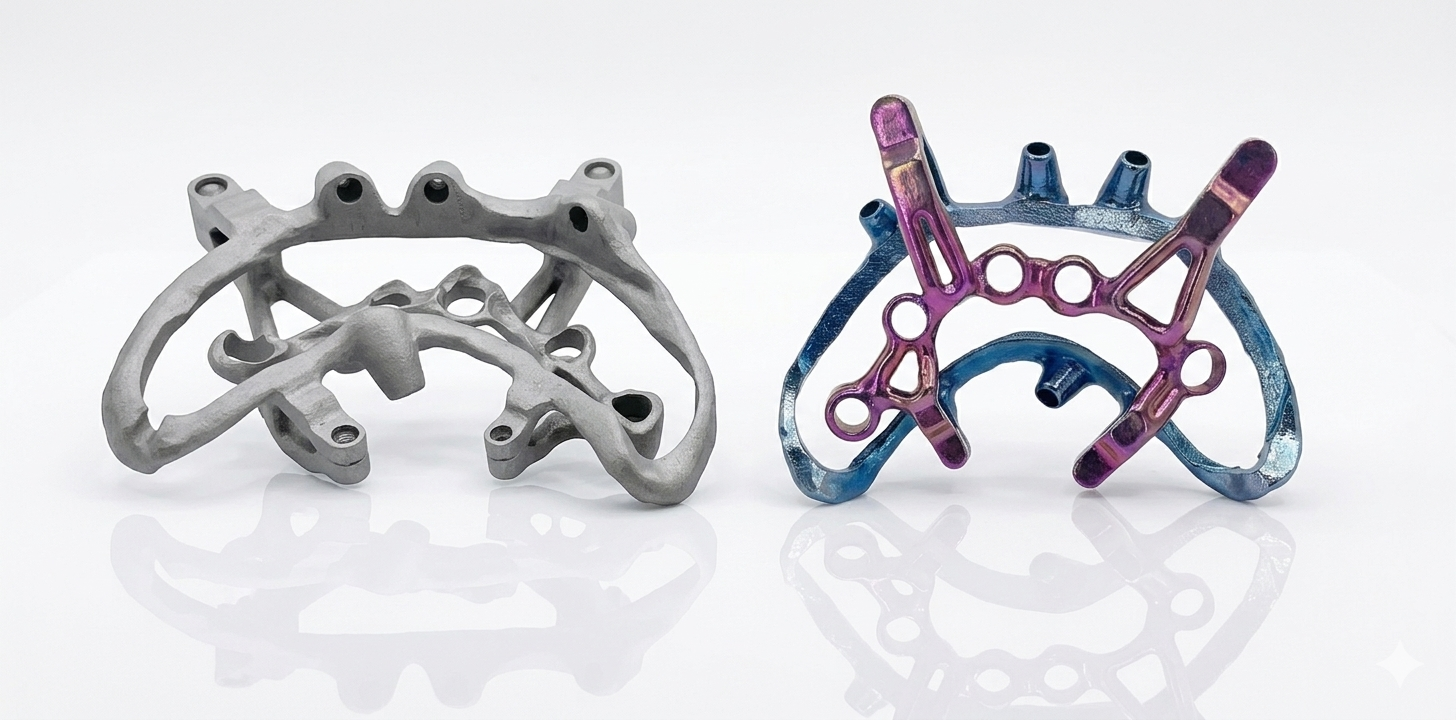
The rough guide, still attached to its backing, already shows remarkable precision.
- Thermal stress relief
Post-printing heat treatment enables:
- release of internal stresses,
- dimensional stability,
- long-term reliability.
This step is essential to ensure consistency between the validated STL and the final part.
- Removal of supports and technical finishing touches
The finishing phase includes:
- separation of media,
- controlled scraping,
Each guide is inspected to ensure compliance with implant standards.
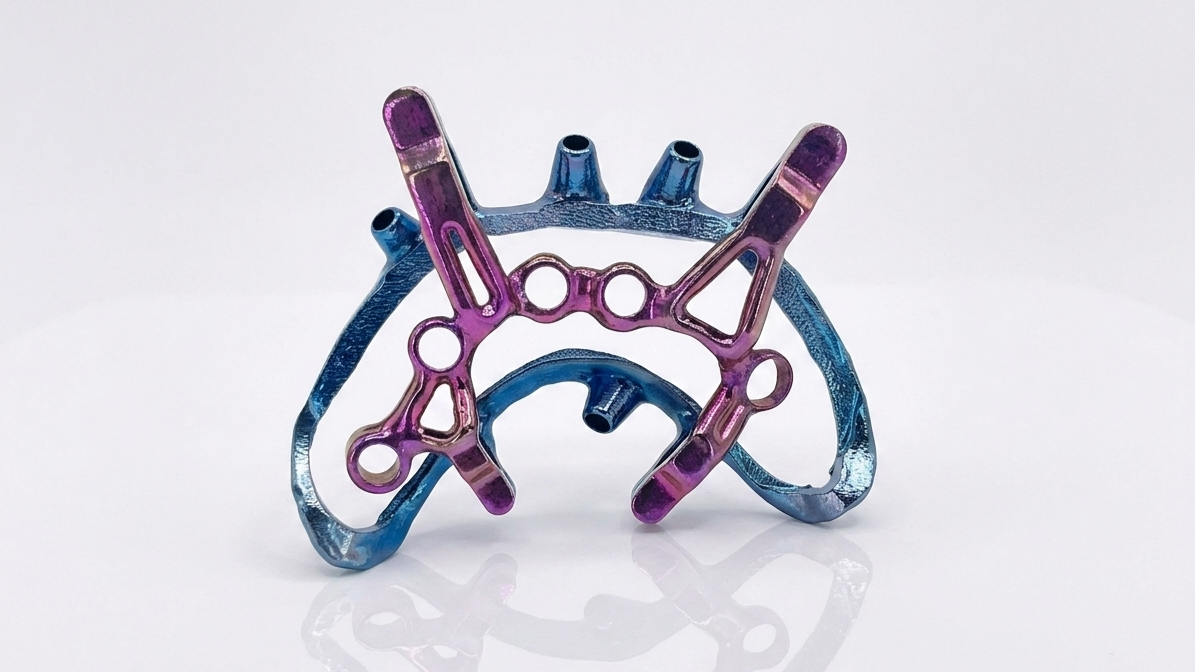
- Anodizing: Ergonomics and Surgical Visibility
Anodizing the titanium surgical guide provides:
- immediate visual distinction,
- better surgical visualization,
- enhancing the device's aesthetic appeal.
It simplifies the intraoperative steps for the surgeon.
Outsourcing for dental laboratories: a strategic tool in implantology
The increasing technical complexity of dental implants requires laboratories to make significant investments: metalworking machinery, industrial expertise, and advanced quality control.
The outsourcing to a specialized center such as Dent All Group allows:
- to access laser sintering for dental implants without requiring a significant capital investment,
- to expand its offerings in guided implant surgery,
- to offer premium solutions,
- to manage complex cases,
- to maintain its profitability.
The laboratory handles the design, implant-prosthetic planning, and clinical coordination, while leveraging a highly technical metal fabrication platform.
In a competitive market, this strategy makes it possible to:
- stand out technologically,
- retain surgical practitioners,
- ensure the long-term sustainability of its operations.
The Evolution of Dental Implants: Toward Industrial Precision
Dental implant prosthetics are evolving toward a model where industrial precision is becoming the standard. Guided surgery, combined with a titanium surgical guide, allows for:
- prosthodontically guided planning,
- a reduction in surgical risks,
- greater predictability,
- optimization of processing times,
- a reduction in mechanical complications.
Laboratories that incorporate these technologies position themselves as advanced technical partners for dental practices.
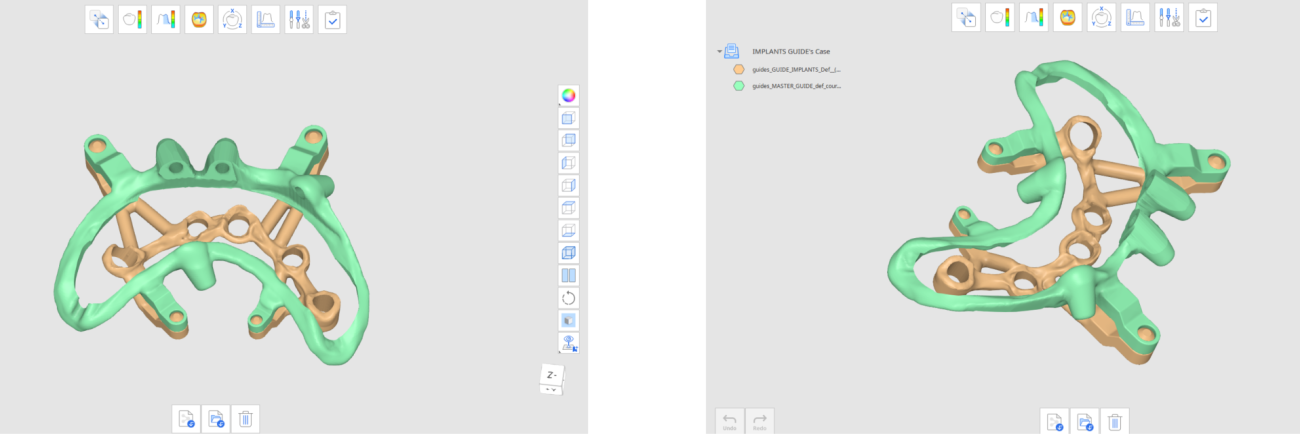
Conclusion: Titanium surgical guides and laser sintering are becoming the new standards in modern implantology
The titanium surgical guide manufactured by laser sintering in implantology is now the gold standard for advanced guided implant surgery.
Rigidity, STL accuracy, thermal stability, and industrial-grade control: each parameter helps ensure the safety of implant treatment.
For laboratories, Outsourcing to an expert center such as Dent All Group allows them to incorporate these high-tech standards without having to deal with the industrial complexities.
In modern implantology, precision is no longer just a competitive advantage. It has become a requirement.