Digital prosthetics
Digital prosthetics
A revolution for dental laboratories
The manufacture of removable dental prostheses is entering a new era thanks to CAD/CAM (Computer-Aided Design and Manufacturing). Gone are the days of time-consuming and costly traditional techniques, replaced by digital precision, rapid manufacturing and lower costs.
Traditional vs. digital manufacturing: what are the differences?
In traditional manufacturing, the production of an adjunctive prosthesis involves a number of manual steps: taking a physical impression, making plaster moulds, wax modelling, mounting the teeth and final polymerization. This process is time-consuming, requires a great deal of human intervention and can lead to fitting errors.
CAD/CAM, on the other hand, optimizes every phase by digitizing design and manufacture. The impression is taken with an intra-oral scanner, enabling a precise 3D image to be captured. The digital model is then used to design the prosthesis via CAD software, before being manufactured by milling or 3D printing. This process reduces human error, improves precision and cuts manufacturing times.
In this article, we explain why CAD/CAM mobile prosthetics are a strategic asset for dental laboratories today, and how they meet market challenges.
The denture market: figures and trends
Demand for adjunctive prostheses (full and partial) is growing fast, driven by an ageing population and increased accessibility to dental care.
Key figures :
- 40% of prostheses performed in France are mobile prostheses.
- CAD/CAM in dental laboratories is growing by 20% a year.
- Digital technology cuts manufacturing time by a factor of 3.
100% Health
The "100% Health" reform introduced a ceiling on dental prosthesis prices, directly influencing transactions between laboratories and practitioners. Sales prices from laboratories to practitioners vary according to the complexity of the prosthesis and the materials used. Here's an average estimate of the prices charged:
- Partial resin prosthesis (1 to 4 teeth): approx. €110
- Resin partial denture (5 to 8 teeth): approx. €140
- Partial resin prosthesis (more than 8 teeth): approx. €170
- Complete resin prosthesis: approx. €250-280
- Stellite (1 to 4 teeth): around €250
- Stellite (5 to 8 teeth): around €300
- Stellite (more than 8 teeth): around €330
These prices are indicative and may vary according to technical specifications and agreements between the laboratory and the practitioner.
The adoption of Computer-Aided Design and Manufacturing (CAD/CAM) enables laboratories to reduce production costs, improve the precision of prostheses and offer competitive prices to practitioners, while complying with the ceilings imposed by the "100% Health" reform.
These trends show that laboratories that invest in CAD/CAM are in a strong market position.
CAD/CAM prosthetics: how does it work?
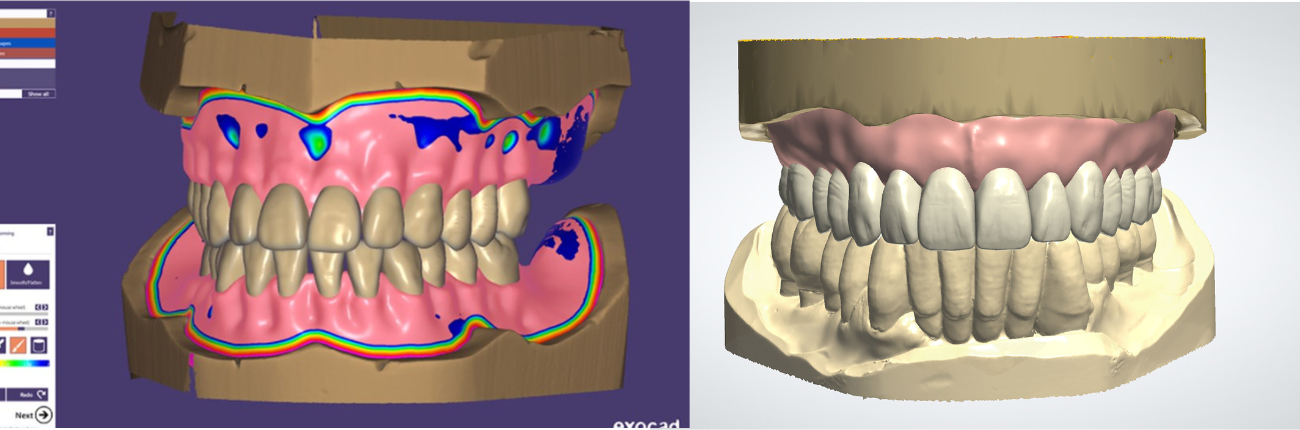
- Digital prosthesis design
The process begins with CAD (Computer-Aided Design). Using modeling software, the prosthetist designs a prosthesis perfectly adapted to the patient's morphology. This stage enables :
- Total customization
- A better fit for prostheses
- Reduced fitting errors
- Rapid repair in the event of repairs or copies
- Manufacturing: milling or 3D printing?
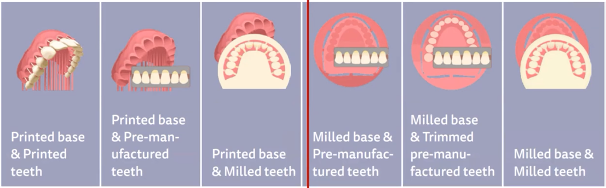
Once the design has been validated, manufacturing is carried out by machining (milling) or 3D printing.
-
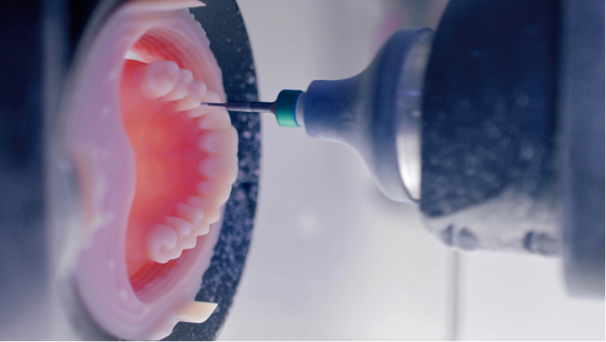
Milling (Machining)
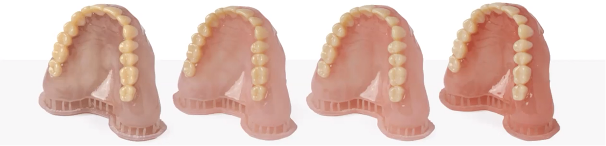
Milling is a subtractive technique in which a machine tool removes material from a resin disc to sculpt the desired prosthesis. This method is particularly suited to the manufacture of full or partial resin prostheses, guaranteeing high precision and excellent adaptation to the patient's oral structures.
Ivoclar's Ivotion system offers monolithic discs combining base resin and prosthetic teeth. These discs enable a complete prosthesis to be machined in a single step, reducing manufacturing time and minimizing the number of adjustments required. Ivotion also offers options with separate disks for the resin base and teeth, enabling more personalized assembly.
2. 3D printing
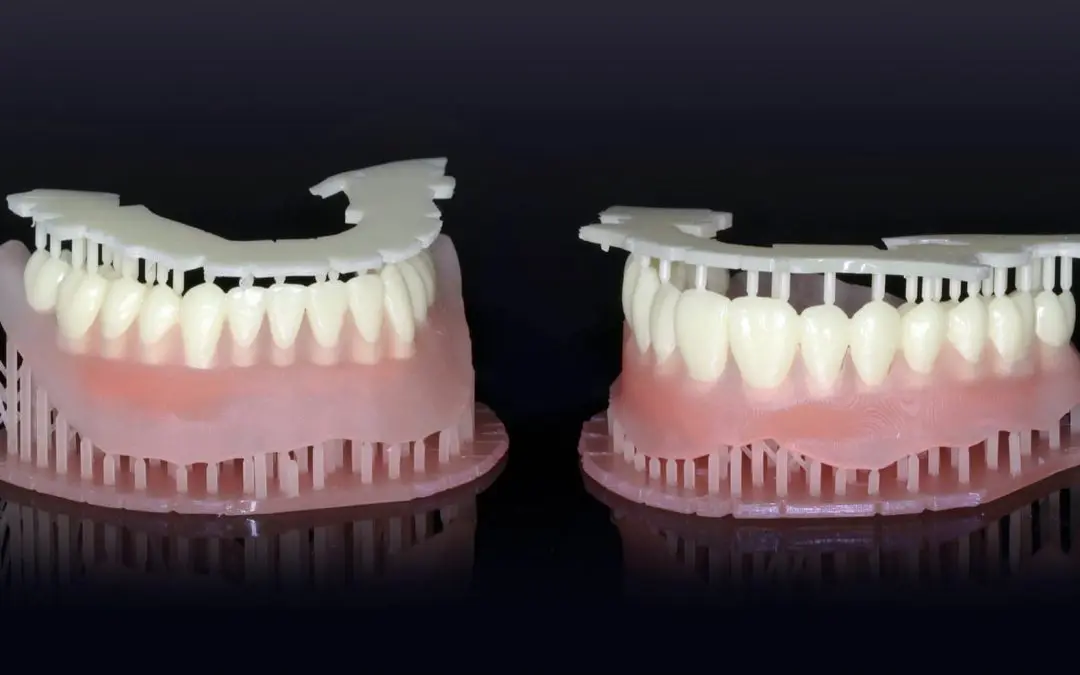
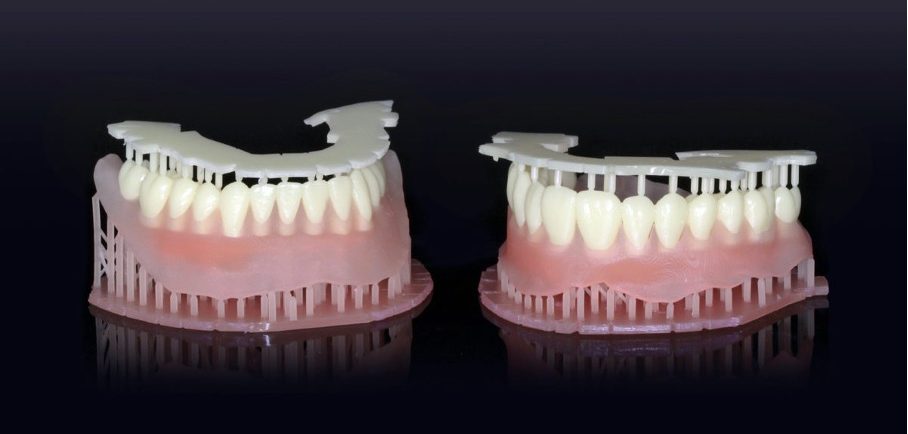
3D printing is an additive technique in which the prosthesis is constructed layer by layer from a photopolymerizable resin. This method is ideal for the manufacture of partial and complete prostheses.
Advantages of 3D printing :
- Speed: Production is faster than with milling. We can therefore be faster on lead times
- Prostheses around 50% less expensive than machining
- Definitive: Today, resins are approved for definitive prostheses.
3. Hybrid approach
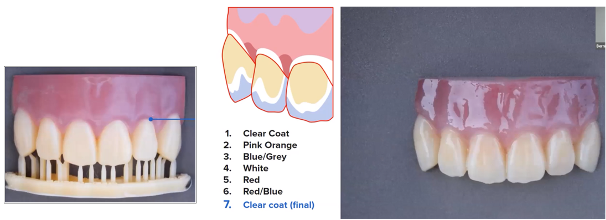
Some laboratories combine milling and 3D printing to optimize fabrication. For example, the base of the prosthesis can be printed to ensure a better fit and mechanical strength, while the teeth can be milled in a final multi-layer PMMA for optimal aesthetic and functional fit.
- Adding hooks using laser sintering (SLS)
For partial dentures, it is possible to integrate clasps produced by laser sintering (SLS). This technology makes it possible to manufacture customized metal clasps, offering :
- Improved aesthetics
- Optimum mechanical strength
- Perfect integration with the prosthesis
Why adopt CAD/CAM mobile prosthetics?
- Lower manufacturing costs
Traditional production of mobile prostheses involves high costs for skilled labor, materials and production time. The artisanal model relies on multiple manual steps, increasing the risk of errors and rework. CAD/CAM, on the other hand, streamlines the process, reducing material consumption and automating manufacturing. Laboratories can cut unit production costs by up to 50%.
- Shorter lead times
With CAD/CAM, digital design makes it possible to produce a prosthesis in just a few days, without compromising on quality. This enables laboratories to increase production volumes and reduce delivery times to practitioners.
- Improved quality and precision
Digital tools guarantee perfect adaptation of prostheses to the patient's morphology, reducing the number of adjustments required and limiting the risk of discomfort for the patient. What's more, CAD/CAM prostheses are structurally homogeneous, making them more resistant over time.
- Independence from skilled labor
The recruitment of qualified prosthetists is a major challenge for laboratories, with a growing shortage of manpower. CAD/CAM makes it possible to reduce this dependence by automating repetitive tasks and simplifying the work of technicians. As a result, a CAD/CAM-equipped laboratory can produce a greater number of prostheses with a smaller team.
Don't be left behind: switch to CAD/CAM!
Subcontracting to Dent All Group is a wise choice, both in terms of structural development and in terms of the flexibility and innovation we can bring to the dental laboratory.
Would you like to optimize your production and increase your profitability? Contact us to find out more about our digital manufacturing solutions for your laboratory.
Gain in competitiveness and efficiency with digital prosthetics!